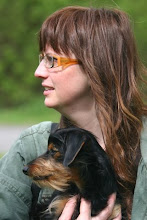
Thanks to these precious models from Old Dog Haven for participating in this visual commentary. Their grassy stylings prove that the wisdom of age trumps the beauty of youth.


What makes human beings want to exploit, dominate and consume the animal kingdom instead of co-existing peacefully with our furred and feathered friends who share our planet?
In his enlightened book An Unnatural Order, author Jim Mason explores this issue with persuasive, intelligent prose. This quote was so poignant and on point that I felt compelled to share it with you.
"Animals have been regarded as property for way too long. It's high time we took on a more loving and responsible relationship with our kindred beings in the web of life on this beautiful planet. I always think and act as a guardian towards my kindred beings, never as their owner."

Seeing a parade of the cutest and most loveable animals is heartwarming. But that is a small part of working at a shelter.
There’s a dark side, too.
Workers on the front lines are there when cruelty happens. Often before the police and other first responders show up, animal control officers -- known as ACOs -- face animals who are frightened and skittish. Sometimes the animals instinctively defend themselves the only way they know how.
With force.
Human dynamics can be confusing for an animal. Human beings -- who might have been responsible for torturing, maiming or neglecting them in the past -- are coming at them trying to help with catchpoles, traps and nets. And with the best of intentions.
But how do they know that?
Sometimes they strike out in fear.
As people, we might technically be in charge of the animal kingdom, but we need to respect animals for who they are, and understand what motivates them if we are to co-exist safely.
That’s easier said than done. And when you are working with rescued animals every day, you can’t be perfect. Mistakes happen. When shelter staff have a bad day, it takes on different context than when an office worker makes an error.
An animal dies. Or a person gets injured, as the following email that showed up in my box this morning illustrates.
For everyone out there reading -- whether you are a shelter worker, a renegade rescuer, or a citizen who might find yourself in a position to rescue an animal, or if you are introducing a new one to your household -- we all need to remember to be cautious. To use common sense.
I’m guilty of being careless occasionally, as you’ll read about on this blog. We all are. I’ll keep posting stories detailing my hapless mistakes hoping someone out there learns from them.
This is the rescuers’ mantra I hear repeated often: “The rescue of an animal won’t succeed if we have to rescue you!”
Today, my heart goes out to the organization involved in this story. I know you feel defeated. Thank you for sharing it, and helping to educate all of us. Readers, please send a caring thought out to them and all the others who save animals. For very little pay and near-zero recognition, ACOs do the job we wish we had the strength to do.
Editor’s Note:
This story is about two pit bulls, but do not let that fact prejudice you against pits bulls! It’s not a surprise pit bulls are often mentioned in shelter stories because of their sheer numbers -- they fill the kennels of most shelters I’ve seen. People insist on breeding these dogs despite the harbinger of doom the names carries. Many pits won’t get adopted because of the stigma that’s attached. The label “pit” is tethered to them like an anchor to a sinking man.
Companies don’t want to issue homeowners’ insurance policies to pit guardians. And one by one, cities, towns and counties are issuing ordinances targeting pit bulls for more rigorous licensing and containment requirements.
Even gentle, gorgeous pits don’t get homes. Many owners eventually just give up and turn them over to the shelter.
Incidentally, pits -- which are not even a real breed, by the way -- show up way down on the list of biters, after dogs like Chihuahuas, Dalmatians and Golden Retrievers. The pit bull classification usually includes American Pit Bull Terrier, American Staffordshire Terrier, and Staffordshire Bull Terrier, but another 14 dog breeds tend to get branded by the media as “pit bulls” when a hysterical reaction follows an attack.
When pits do attack people, it’s usually because human beings have used them as weapons, victimizing the dogs. The loyal, obedient nature of these dogs combined with their strength makes them the weapon of choice for vicious people, drug dealers, gang members and other criminals.
The names in the following story have been changed.

Chihuahuas are more aggressive than the average pit bull.
Shelter work can be dangerous if protocol isn't followed
We had a dog bite at the shelter yesterday.
Nikki is new at the shelter. She came to us after becoming thoroughly discouraged as a social worker facing constant need with few results.
She has a black pit bull who has never shown aggressive behavior. She brought him to the shelter to introduce him to another pit she was thinking of adopting.
After a morning of staff training, Nikki put the pit she was interested in taking home in the exercise yard. Then – alone - she led her pit out to the yard on a leash. All hell broke loose. The dogs attacked each other. As she was breaking them up, her own pit grabbed her arm and began shaking it violently.
Staff workers heard the fight and Nikki’s screams from the administrative building and came running out. They saw that Nikki was in trouble. Arriving at the gate to the yard, they found it padlocked. The door to the shelter, only feet from the gate, was locked as well. They were trapped outside the fence as Nikki’s arm was ripped and torn apart by her dog.
Banging on the door window, they summoned for help. When someone opened the door, they were able to enter the building and race through the kennels to access the yard where the fight was taking place. Thankfully, the door leading from the kennel to the yard always remains unlocked during the day. Only the gate is secured to discourage thieves, and dogs, from opening it.
Within minutes, we had a police car, fire truck and ambulance on the scene.
One dog’s ear was torn. The other has a few scratches. Nikki went to the hospital.
Nikki's supervisor Samantha is deeply disappointed and angry. She would like to think her officers have the knowledge to keep them safe on the streets. That belief was shattered when she learned that she has some staff members who can’t even stay safe in the shelter.
Mistakes Nikki made:
1) No one knew she was out in the yard with the dogs.
2) She was trying to introduce two very strong, potentially aggressive dogs alone.
3) She isolated herself in a locked area.
4) The only dog she had any hope of having voice control over -- her own -- was the one dog on a leash.
5) She was introducing the dogs in a high-stress area, the yard outside the main kennel.
I am sure Sam’s staff will learn about Nikki's mistakes intimately.
The sad thing is that Nikki had mentioned to several people, ACOs and others, that she would be introducing the dogs after the training meeting. No one offered to help or thought to ask her who would be helping her. Nikki was sadly mistaken about how she decided to handle the introduction. But I can’t help sharing the responsibility for what happened with those who knew what she was planning. Nikki has only been around for a few months. She is still green. Everyone assumed she was knowledgeable, and offered no advice or assistance.
In our profession, we can’t afford to assume. Even at the risk of insulting someone’s intelligence, we have to ask, confirm, and find out for sure that our new people know what they are doing. So often we think people know things so we are afraid to open our mouths, even when we have a fleeting thought that they just might not know. Or a personality conflict causes us not to help someone as we would those we like or feel close to.
We held Nikki while she cried. After her concern for the dogs, Nikki was most upset about being so stupid. She was also having difficulty as she questioned why no one had told her that her plans were faulty. She was hurt on many levels.
What a harsh lesson to learn. For all of us.


 This heated cat house at Heather's place provides cozy and stylish accommodations for feral cats living outdoors.
When the weather warms up enough for spring blossoms to start showing their colorful faces, it's not just human beings who have an extra spring in their step. Stray animals in cold weather climates can finally get some relief from the harsh conditions.
In wintertime, strays might freeze to death, or get frostbitten ears and paws. They have trouble finding water because it's been frozen to ice. Food gets buried under the snow.
I grew up in one of Canada's coldest inhabited regions. In the excruciating deep freeze of Winnipeg, Manitoba, temperatures can dip to minus 50 degrees Celsius with wind chill. Unexposed skin suffers frostbite in less than two minutes. Cars require block heaters that must be plugged in when vehicles aren't running or the engine fluids will freeze.
It was the bitter sting of a Winnipeg winter that brought my first cat to me. It was 1975, and a blinding 23-hour blizzard had shut down the city. I was six, my brother was four. We wandered into the living room and stopped in surprise.
Sitting outside on the ledge of our front room picture window was a grey tabby cat. She stared in at us imploringly. Raging winds swirled sheets of white snow around her. She looked like a guppy as her mouth opened and closed in a pleading meow that was silenced by the glass that lay between us.
We quickly brought her into our warm house, where she promptly made herself at home. "Kitty", as we called her, would live to be 19 years old.
With a bit of effort and a touch of creativity, you can help strays in your community, too. This next story comes from Heather McKnight, another Winnipegger I've known since junior high school. Our mutual love of animals caused us to reconnect recently.
It turns out that besides being an animal rescuer, Heather is also good writer, so I asked her to tell her tale about how she saved two feral cats.
Editor's note: When at all possible, I do not condone cats living outdoors. They are exposed to many dangers including licking antifreeze or other poisonous substances. They crawl into warm car engines where they get ripped apart by fan belts. They get locked in places such as sheds and garages. They might also be victimized by angry children or adults in the neighborhood -- I've seen cats who have been shot by BB guns, wrapped in wire, or otherwise tormented. But in some instances, particularly in the case of feral cats, a life outdoors is unavoidable. The following story illustrates one of those times.

Raven and Finnegan found love, safety and food at Heather's house.

Heather relaxes on her live dog pillow, five-year-old Scooby Doo.
Homeless cats luck out when a guardian angel crosses their path
By Heather McKnight
It was the beginning of April and winter was finally giving up its hold on Winnipeg. The sun was shining, the snow was melting, and the ditches were filling with water. Driving home one early evening, I decided to slow down past the house that some neighbors had moved into the previous summer. They had been renovating and I was curious to see how far along they were.
The whole family was out in the yard. The three boys and their friends were playing in a shallow, ice-filled ditch at the side of the house. Mom and Dad were stacking firewood just a few feet away. But that was not what caught my attention. Outside by the house front window were two tiny black cats.
In the country, this wouldn't normally wave red flags. But my curiosity was raised because there were also two larger cats outside. The owners of the house in question, while nice, caring people, have no patience to take on more than what they feel is necessary.
I pulled into the driveway and got out of my car, making my way over to the small black cats. It turned out they were kittens. The woman told me that the mother cat had abandoned the kittens the previous fall. The kittens had stayed around the house.
When the cold weather came, this neighbor had made them a lean-to against the house to keep them out of the wind and snow. She had been feeding them during the winter but she said it now it was time for them to go. She didn't want them to make a mess in her front gardens. This is what she considered beyond necessary.
I asked if she would be taking them to the animal shelter. Her answer was not what I had expected. Her husband was going to put them in a box and drop them off at a barn down the road.
I was horrified. I knew which barn they were referring to. While it was probably great for the cats who actually lived there by rights, it was not a place for young kittens without a mother. I knew that many of the kittens that had been born in that barn or dropped off there had been hit by cars on the nearby road. Or found frozen to death because they had wandered too far away from its shelter.
I was not going to let tragedy happen. I told her I would take both of them.
I took a quick drive home to get a carrier so I could pick up the kittens. They were so tiny. Both had a touch of frostbite on their ears, and they were skittish.
The neighbor said they were very friendly, and that her boys were able to pick up the female and carry her around. It soon became clear to me that if they had been hauling these cats around, it hadn't been because the cats had a choice.
Once at home, I put them in the office. This space worked well because it is large, I could put their litter box in the bathroom, and it got wonderful afternoon sunlight. Also, it was their own space protected from the two dogs and three other cats that already lived in our house.
Until they were used to the family, I wanted them to have their own secure spot.
They quickly adjusted to being inside, but their skittish nature remained. The male, Finnegan, was the most responsive. He would let me get close to pet him, and occasionally he would allow me to give him a snuggle. The female, Raven, was harder to get near. You had to give her a food bribe just to get close. Both put on some much-needed weight in the first few weeks I had them.
Then things got a bit interesting.
I wasn't sure of their ages. Before I could get them fixed, Raven went into heat. I have never experienced this with a cat before because I've always had them spayed or neutered before biology allowed this to happen.
Raven took one look at my neutered male cat Scrappy while she was in heat, and that was it. She was in love. She strutted around him. She was demure, she was coy. And she was very aggressive.
Poor Scrappy. He was out of his league. This behavior was completely foreign to him. He would smack her with his paw and wrestle her to the ground. Her response was to take it, and then wiggle her backside at him. He looked completely confused.
She was at the vet clinic within 24 hours. So was Finnegan.
Having decided five cats and two dogs were just too many animals in one house, my husband built a cat house outside for our new family members. Standing a few inches off the ground, it measures 4 feet by 2 ½ feet by 3 feet. It is completely insulated with a front door and two side windows for light. The door is large enough for the fattest cat, but small enough so the dogs can't get in. It even has a little front porch.
There is enough room for a large bed area, and space for food and water. Intended for year-round use, it includes a socket for a heating lamp to be hooked up inside to keep the cats warm during the coldest winter nights and days.
The day finally came to move the black furballs to their new house outside. It was just a couple of yards from my back door, where it would be easy to keep an eye on them. The nights were no longer freezing, and the days were growing warmer.
Finnegan was first. Gathering him up in my arms, I took him outside for the first time in over a month. Taking him to the new house, I explained what was going on. That I would always feed and protect him. He could come inside anytime he wanted, but this would be his home base.
He didn't buy it. He shot in, he shot out, and he disappeared under the deck of the house. Next it was Raven's turn.
Same scenario. As soon as I popped her inside the new house she bolted out. I thought she went under the deck to be with her brother Finnegan.
My sons and I started circling the house. We looked under the deck, around the woodpile, the shed, the cars. Still no cats. The only remaining option was the woods. There is a small wooded lot to the south of our house, and one to the east. We searched and called to no avail.
As we stood outside wondering where on earth she went, my oldest son said to me, "Mom, maybe you should look at the living room window."
When I looked up at the large easterly window, there sat Raven. She had snuck inside and had been watching us while we had been looking for her. Sitting on the window ledge, she peered through the glass at us with a look on her face that said to me, "Really. You think I am going to settle for that? You think after sleeping on feathers and cushions in a heated home, I AM GOING TO SLEEP OUT THERE IN THAT?"
She has never forgiven me for having her spayed. She and Scrappy have bonded despite the aggressive early dating maneuvers. She spends most of her time in the house.
Finnegan has adapted better to a life outdoors -- hunting mice and roaming with the other wild cats in the area. But he's not a completely feral animal. We spot him on an occasion, silently slipping between the undergrowth of the forest, or sneaking into the herb garden for a hit of catnip.
Sometimes, early in the morning before the sun has started to rise, I spot him sitting on the back porch waiting for the dawn, enjoying the free meal I leave out for his comfort and sustenance. I think he's pretending just for the moment that he's domesticated.
But that's our secret.

 Felix offers his paw and comes in for a closer look.
Have you ever noticed that human beings don’t pay much attention to the nonverbal signals we give each other? We get so wrapped up in our own personal dramas that we don’t evaluate clues offered by people around us.
Animals are smarter than that.
Like the wise gaze of an old magnum opus, an animal’s eyes follow their people around the room whenever they make a move. Their survival instincts are honed to gauge mood and behavior. And danger.
There are some human beings who have learned that it’s in their best interest to watch others more closely. Criminals in prison, for example. And victims of violent crime.
But in the case of animals who find a safe home to live out their time, it’s pure love that drives them. They can’t wait to see what we’re going to do next. Perhaps that’s why animal lovers find the riveted attention of their pets so intoxicating. Who doesn’t want to be the center of someone’s world? A search for Little C is conducted in the crawl space.
I got one of the worst frights of my life last night.
The evening had started off peacefully. I’d fallen asleep on the couch watching Law & Order. When I awoke, I decided to check on Little C in the master bathroom, where she had been napping.
I pushed the door open, but the room was still. Deathly quiet. Little C wasn’t on her bed. I ripped apart the pillows and blankets, calling out for her in vain while I searched the small space.
Moments later, a sickening reality crept in. There was only one plausible explanation. Little C had gone exploring, and had gotten herself stuck. She had to be lodged somewhere in the house’s innards.
It wasn’t a stretch for me to reach this conclusion. Many times I had seen and heard of rescues that began like this. Cats trapped in tub enclosures, walls, crawl spaces. Their curious natures draw them to the tiny dark tunnels. Sometimes they can’t make their way back into the living space. Or if the house is under construction, they might be accidentally bricked in by workers.
If they are fortunate and someone responds to their cries, they are pulled out skinny and dehydrated, sometimes weeks later. I always encourage people who have lost their cats to search outbuildings recently locked up for the winter, such as garages and sheds, as well as new construction sites.
And now it had happened to Little C.
As a responsible pet guardian, I should have known better. Dangers lurk in my house. It’s relatively new -- cosmetically unfinished -- with many nooks and crannies. Round holes where speakers are supposed to fit. Square holes for control panel hook-ups. Wires protrude from the cut-outs, ready to be put into service on the day when I finally decide. Scattered throughout the house are rectangular holes on the floor that connect to the heating system. Metal grates were intended to sit in them. But all of the grates have been removed.
Cats with territorial tendencies mark ground with their urine. A common spot for cats everywhere to frequent is in the heating grates. They treat them like those third-world toilets in the floor.
In my cat house, the vents have been closed off with flat pieces of rubber to protect them. But the only way to get a tight seal against the wood floor was to remove the metal grates. When it gets so cold that the heat has to be on, I push the rubber panels back a bit to let warm air pump through the house.
I was certain Little C had squeezed herself through the small hole the heat was coming through, perhaps looking for extra warmth as cats tend to do. She’s a small cat. But still I had my doubts. She has gained a bit of weight lately. It would have been a tight squeeze.
I lay down on the floor, put my face to the opening and started calling, “Little C! Little C!”
Silence. Little C is normally a chatty cat. If she was conscious, she likely would have meowed back. I stuck my hand into the metal duct as far as it would fit, groping around for her warm, furry body. My fingers touched a body, but it wasn’t Little C. Wrapping around something familiar, I pulled the object out. It was Doll Favorite!
Now panic started surging through my body. I was electrified with dread. My mind had put the puzzle together. Little C must have dropped Doll Favorite into the duct, and gone after her in the hopes of retrieving her best toy. She had tumbled into the rabbit hole like Alice in Wonderland, and now she couldn’t claw her way back out. I pushed my arm in deeper and found a foam ball, and a hard-shelled plastic one I had filled with catnip for her.
I tore out of the room and headed for the basement. That’s where I could access the crawl space. I climbed a pallet rack and pried off the makeshift wood trap door, hoisting myself into the dark, dank space that runs under the house. The ducts that snake under the foundation carry warm or cool air to each room. I calculated where Little C would have fallen into the hole. It was the furthest point from me. I would have to crawl along like a worm until I made it to the opposite end.
I am intensely claustrophobic. To me, the crawl space wasn’t just a dirty, cobwebbed inconvenience. It felt like being buried alive. But after three seconds of hesitation, my maternal instincts kicked in and buried my fears.
If Little C was in there, I wanted to be in there with her.
I crawled along, feeling the plastic-wrapped insulation with my hands until I detected a heavy spot. That had to be her body, I thought. I called and called out to her, putting my face against the plastic, but I couldn’t hear her respond. I couldn’t risk slicing through the plastic with a utility knife -- she would be badly cut if I missed.
It took some time to pry the ducts apart. Luckily Little C had some help from her Hero. When the tube was finally opened, the source of the extra weight was revealed. A bunch of Little C’s toys fell out, including another doll from her trio. But Little C was nowhere to be found.
I decided to patrol the house and see if she had made her way back through another opening into the living area. I was searching the main floor when it hit me.
It wasn’t Little C who had fallen into the rabbit hole -- it was me.
My brief catnap had snatched my memory of the present momentarily. I had completely forgotten that I had put Little C in the holding cage, just like I had recommended to readers in an earlier post (Cats love the velvet paw treatment, February 9, 2009.) After I placed her in there, I dozed off as the sun went down. When I woke up it was dark. Her black coat blended in with the plastic carrier’s dark color. She’s usually vocal about getting out after a few minutes, but decided to stay silent last night.
When I got to the cage and peered in, there she was, right where I had left her. My embarrassment over my over-reaction was overwhelmed by another feeling. Pure relief to find her safe.
And the jolt of pet parent panic wasn’t a waste. It was a wake-up call. From now on I’m going to do better at cat-proofing my house. And myself.
 Little C is notorious for her playful, mischievous personality.
 This dog spent his days in the darkness of this dirty shed. Note his nose poking out from the bottom left corner of the yellow door.
Even the sweetest day of the year doesn’t give dedicated rescuers in the field pause from heartbreak.
While many people celebrated love with their heart throbs on Valentine’s Day, I was consoling a New Orleans animal control officer whose heart had been torn apart. You met 22-year-old Melanie Fenwick last week. She’s the red-haired rescuer who came upon three dogs existing on a trash-strewn, derelict property.
The place is like so many others that litter the post-Katrina wasteland. Buildings that were submerged under dirty floodwaters are moldy, tattered shells.
In this case, two three-year-old pit bulls were being housed in dark, dilapidated sheds. The third, a five-month-old puppy, was clamoring to escape from the cab of a junked pick-up truck.
During one site visit, Melanie found a dog tethered on a heavy chain next to a burning pile of debris. There wasn’t even a bowl of water to quench his thirst as he sat breathing in the toxic fumes.
Melanie and her partner Travis Causey hoped they could orchestrate a happy ending to this story. They instructed the dogs’ guardian to make changes towards improving their welfare.
“Those pictures were not the worst ones,” said Fenwick, referring to the photographs posted to the blog story, Officers help dogs living in dismal conditions, February 10, 2009.
There isn’t a happily-ever-after ending for these dogs.
On Friday, the case went to court. The owner struck a plea bargain. He agreed to relinquish his two older dogs to the Louisiana SPCA. In exchange, some charges were dropped – a neighbor had spotted one of his dogs roaming at large, and none of them had rabies vaccinations. But the neglect charges stuck, and he pled guilty to three counts. One for each dog.
Now the fate of the two dogs turned over to LA SPCA had to be decided.
Prospects for pit bulls needing homes are grim at best, hopeless at worst. Most shelters I visit are overloaded with them. Many shelters won’t even put them up for adoption, fearing liability to their organization, or mistreatment of the animals. Pits are often euthanized upon arrival. Some organizations will consider adopting well-behaved pit bulls if the dog -- and the potential adopter -- pass rigorous assessments.
Louisiana SPCA does place pit bulls. But tragically, the dogs rescued in this case have several strikes against them. They aren’t babies anymore. At three years of age, people will look right past them and gravitate towards the plentiful puppies. And they tested positive for heartworm. The mosquitoes nurtured by the steamy climate of the bayou carry the parasites. The disease is expensive to treat and requires weeks of quiet rest. It’s not practical to offer this peaceful convalescent environment in the shelter’s chaotic setting.
And the pit bulls seized have other marks against them -- significant scarring to the skin that might be viewed as battle scars.
“We don’t want them fought, and we don’t want people coming into the shelter thinking, ‘Oh, this is a good fighting dog,’ ” Melanie said. “Nothing with scars goes up.”
The dogs were scheduled to die soon, this past Friday or Saturday perhaps. I don’t know if they are still alive. If they are, their time is coming. Possibly as you are reading this. Take some comfort in knowing that, unlike how they were treated in life, their deaths will be handled with humanity and compassion.
If you feel compelled to act and memorialize them, there is something important that you can do. Educate someone you know who is thinking of breeding their companion animal. Whether they own a pit bull or another type of animal, you will be saving lives. There is an epic overpopulation crisis. There are simply not enough homes. It’s time for all of us to act.
Back in New Orleans, the sheds where the dogs lived in misery have already been torn down by the landlord.
“His house really shouldn’t be inhabited,” Melanie said. “He didn’t have a proper place to put the dogs.”
Melanie won her case. But she’s frustrated. The win begets a loss. Unlike people who minister to human beings, animal rescuers aren’t just tasked with saving their charges. In many cases, they are also responsible for deciding who lives, and who dies.
Melanie consoles herself with the knowledge that their last few days at the shelter will likely be the best times for these dogs. And like most rescuers I meet, she’s more worried about the dog going home than the ones scheduled to die. The five-month-old puppy will be returned to his guardian this week. Melanie will be back to check on him soon.
“I care about the well-being of the dogs,” she said. “It’s good that they’re not going to spend the rest of their lives on the end of a chain. They won’t have to live through that again. At least they’ll have shelter and food until the end."
 Big Bird is back in flight following a near-death experience. Photo taken by Pat Maloney.
Rescuing animals has found its way into my heart for many reasons, not the least of which is a family matter.
There are dedicated animal lovers on both sides of my family -- parents, grandparents, aunts and uncles. One great-grandfather was even the state veterinarian for Zimbabwe back when it was still called Rhodesia. Relatives who were gone before I was born are posed in old photos holding beloved dogs and cats. Their animals were important enough to be included in the black and white shots long before digital cameras stored thousands of pictures with a few clicks of a button. Back then, setting up a photo was an ordeal.
But no family member loves animals with the passionate fervor of my mother. She carries cat food and a dog leash in her large purse in case she comes across strays. She’s trapped feral cats to spay and neuter, and reported dogs locked up in hot cars to the authorities.
And she doesn’t just help companion animals. She rescues wildlife facing danger, too. Near her place in Florida, she’s pulled her car to the side of the road to pick up wayward turtles and help them safely cross the road. She’s cordoned off burrowing owls so people won’t threaten them while they are vulnerable in their habitat, which consists of a shallow hole dug in the dirt. She even makes sure the runners on her windows are gecko-free before she shuts them to avert tragedy.
The latest recipient of her creature compassion is Big Bird, a great blue heron who had nearly met his demise by the time she spotted him. Poisoned and confused, he was flying “as if he had lost his GPS”, Diana Maloney said.
She quickly got in touch with a local rescue group who agreed to come right over and try to catch the bird. Diana was “absolutely gobstruck” watching Dan the Bird Man at work, and she writes about his techniques in her story below.
“He just dove on it,” she said. “At one point I looked away. I couldn’t bear to see. I was expecting to see a squished bird, but he actually dove onto his elbows and knees. You only get one shot at it.”
The situation was dire. He couldn’t miss. If he did, Big Bird wouldn’t survive one more night of a cold snap in usually sunny Sarasota. The temperature had dipped below freezing several nights in a row. Herons are skinny birds without much meat on their bones to begin with, and this one was significantly underweight.
But in an update I received today, I found out that Big Bird wasn’t fully cognizant of his near-death experience. He showed zero gratitude towards his captors, who helped save his life by warming him up in their toasty intensive care unit and nursing him back to health.
“The girl phoned me from the rescue center and said this is one pissed-off bird,” Diana said. “He is so mad. She went in with the fish, and he puffed out all his feathers and he put out his wings, and he charged her.”
Below, I've posted the story she wrote on the rescue.
 Diana Maloney prepares to release the bird she rescued. Thanks to her quick thinking, he won't be getting his angel wings just yet.
We are privileged to look out over a fairly deserted beach. Deserted but for the wildlife that abounds there, both on the sand and in the water. Arriving home, I looked up and was horrified to see a beautiful great blue heron fly straight into our building. And then plummet to the ground. He stood up but didn't attempt to move. I went inside to observe "Big Bird" from the foyer. My fear that he was in trouble was confirmed when he staggered away, turned, and flew back into the building again.
A call to the Wildlife Center of Venice brought us the help we urgently needed in the form of Dan, a volunteer from Bradenton. I don't know exactly what we expected, maybe the use of a tranquilizer, but we were definitely not expecting what followed. On arrival, Dan quickly jumped out of his truck. We pointed out where Big Bird was hiding between some bushes and the property fence, with just his head showing. Dan ran back to his truck, grabbed a large net, attached the pole handle, and went into predator mode. Crouching low to the ground, out of sight of the bird, he scurried towards him like an animal hunting prey, poised to pounce. He made only one downward motion with the net. It covered and encircled the bird. He seemed to almost drop to his knees and elbows and cover the bird. By this time, Big Bird was squawking loudly and not happy.
When Dan emerged from the heap, Big Bird was safely tucked under his left arm and his right hand held the bird's neck just below the head. The net had done its work and lay on the ground. Before placing Big Bird in the rescue carrier, Dan carried out a deft cursory check for injuries. As he held the bird tucked under his left elbow, and held the head with his left hand, his right hand moved quickly over the top of the bird’s outstretched wing. And then the same procedure on the opposite side. No palpable injuries. He checked the eyes – membranes were all open, a good sign. A closed membrane could mean he had suffered a concussion.
But Big Bird was not acting normally, Dan told us, and so would need further examination by a vet.
Today, I was contacted by the rescue center. They believe this bird is less than a year old. Through a process of elimination, it appears that he may have botulism poisoning from ingesting dead or contaminated fish, or even cigarette butts. He is underweight, which indicates he may have left the nest too early and not yet be proficient in the art of hunting for food. His treatment will include flushing the toxins through his body repeatedly, maybe administering sub-cutaneous fluids, and possibly feeding him intravenously until he is well enough to be released back to this area.
Here’s a closing thought. Wouldn't it be great if instead of taking the youth of Sarasota on a hunting trip, as is happening this weekend, they were taught the art of capturing wildlife in the manner that Dan demonstrated? This skill could save a creature's life, rather than ending it.


I’ve got another illuminating update from the field filed by webmaster Shelly Patton of the Louisiana SPCA. She’s been riding along with animal control again.
Her story struck me hard. I felt like I was riding along with her. But what resonated most was the importance of citizen involvement. Filing a report when you witness animal neglect or cruelty can change an animal’s destiny.
Sometimes taking action involves a bit of legwork. Animal control for a particular region might be handled by the city, or contracted to an independent agency such as an animal welfare organization. If at first you don’t track down the organization with proper authority, don’t give up. Ask around. Over the years, I’ve reported many people in a multitude of cities. The results were satisfying.
As you’ll find out when you read Shelly’s story, a few telephone calls on your part can make a dramatic difference to an animal’s treatment. We owe it to the animals to speak out and get involved. If we don’t, who will?

Here's what Shelly reported:
Officers Travis Causey and Melanie Fenwick had been at the address the previous day responding to a “roaming at large” call. The first thing they noticed when they arrived was a pit bull puppy in the cab of a blue pick-up truck. The puppy was excited by our arrival. Jumping at the window, he was clawing to get out and greet them.
Walking past the truck, they climbed the weather worn stairs and knocked on the door. They surveyed the yard below. Debris was everywhere. The yard had the junkyard appearance so common in low-income areas.
Just past the driveway sat the pickup truck nestled in overgrown vegetation. The truck was waiting for “someday” to arrive. Its hood was opened in a silent scream. The passenger window was hanging precariously in its frame. The back right tire was deflated and the truck bed was filled with debris. At this point, it was nothing more than a kennel. A dangerous kennel.
Hearing the door open behind them, Melanie and Travis turned and told the man answering that they were there responding to a complaint. They asked if he had seen any strays roaming. “No. No dogs,” he said. “The only dogs I seen are mine. I have them out back. Want to see them?” He spoke of his dogs with a sense of pride. He didn’t think he was doing anything wrong.
As the man walked them around to the back, he was questioned about the puppy in the truck cab.
The backyard was worse than the front: overgrown, littered with empty bags of dog food, dirty cracked buckets, cans scattered about, broken furniture, discarded piles of plywood, and trash.
A dilapidated shed stood to the right. It had no doors or windows. Even sections of the exterior walls were missing. The inside was falling apart, just a framework with crumbled sheetrock hanging here and there. Years of dust and grime held it together. The floor was a build-up of paper, sheetrock, 2x4s, and filth. This shed was home to a white female pit bull. The 10-foot chain securing her to the doorframe was G80, a large, heavy tow chain. Perhaps at one point the chain had belonged to the truck out front. Now it was dead weight around the dog’s neck.
Beyond the first shed sat a second. This shed had a door and tightly boarded windows. The only light filtering into this enclosure came through a hole in the bottom left corner of the door. It was just large enough for the muzzle and eyes of a large dog to fit through. The officers were being watched.
Melanie and Travis began to educate the man about city ordinances concerning dogs and basic standards of animal care. He was in violation of many of them.
They explained to the man exactly what laws he had violated, and the consequences he would face if he didn't raise the standard of care for his dogs. They informed him that an officer would return to verify that he had made the changes necessary to comply.
Some situations require the animal be removed from the property immediately. But that wasn’t the case on this call. Ninety percent of the complaints animal control officers respond to require only education and condition checks. Many people don’t know they are doing the animal an injustice by the way they are keeping them. When the animal’s needs are outlined, they often make changes willingly that are in the best interests of the animal.
Primarily, animal control officers are community educators. They speak for the voiceless, advocating for them to people who love their animals but just don’t know any better.
Melanie and Travis had scheduled this man’s condition check for a few days later, but when time allowed for the visit the next day, the officers didn’t hesitate to arrive earlier than scheduled. Particularly because of the puppy and chained dog involved.
We walked around back to have a look.
The white pit bull – now unchained – was watching us through the hole in the door. The man enthusiastically told us the cab puppy was now in the house. Two major issues had been resolved.
The man opened the shed door so the officers could get a better look at the dogs and the conditions inside the shed. Out ran the white pit bull. Accompanying her was a blue male. Both were a bit on the thin side, but by no means emaciated.
The man told us he let them out at least once a day to run around. Judging by the way they stayed in the area, I believed him.
At one point, the female ran by, kicking up a kitchen knife lying in the weeds near a pile of wood. As the metal flashed in the sun, it caught Melanie’s eye and offered her the perfect opening for explaining the importance of removing all debris from the immediate area. She set parameters for the clean up, emphasizing the dangers that debris posed to the paws of a running dog.
Travis and I went into the shed. Although it was dark, the darkness was not a violation of city code. Travis noted that there were two bowls of clean water and two empty food bowls. There was only a small amount of fecal matter on the floor, an indication that the man did clean up after his dogs.
But the smell was a problem. The air was thick with ammonia. Travis patiently explained something needed to be done about the buildup of urine on the floor. Cleaning the floor using a mild bleach solution once a week should do it. Travis told the man, “You want to take as good a care of your dogs as you do your children.” To me, it appeared that his statement sparked a dawning enlightenment in the man. Travis had given him a visual he could understand.
The focus turned to the condition of the dogs themselves. “Feed them a little more. They are too thin,” Travis added, pointing out a few obvious medical conditions that needed addressing. The female had a bloody tail tip. The male had a minor skin condition, and possibly an ear infection.
After running through the list of requirements the man had to complete and sustain, including yard clean-up and a veterinary visit, another condition check was scheduled. Officers will return in two weeks to verify compliance.
What struck me about this experience was the man’s willingness to do right by his dogs. He had already made some of the necessary changes he had learned about the day before. I got the impression that he cared. He just hadn’t known any better.


 Louisiana SPCA animal control officer Melanie Fenwick cuddles a pit bull puppy. I snapped this photo of her at a temporary shelter set up by LA SPCA in Baton Rouge. I fled the city with staff and the shelter animals this past September when Hurricane Gustav rolled in.
 Sam and Felix enjoy a friendly headlock.
On Saturday I promised to tell you how to operate a harmonious cat house.
After spending some time over the weekend thinking about it, I’m wondering if I’m qualified to answer that question. I still have a lot to learn.
It’s true that I’ve rescued hundreds of cats, and fostered many of them in my home. And with a current head count of nine, I have more pets than most people.
But I’m always picking up new tricks from other animal rescuers.
Take my friend Carol Reichert at Richmond Animal Protection Society, for example. She’s the one who taught me the best way to safely introduce a new cat. Set up a large cage in your living space and let the new arrival spend some time in there each day. This gives the cats a chance to get used to each other. Nobody feels threatened. When the new cat isn’t in the cage, he should be confined separately in a room. Just letting a new cat loose in the house to fend for himself is emphatically the wrong way to make an introduction, causing rifts that can last a lifetime.
I am going through this process right now with Little Carreen, who has been living in my house for a couple of months and is still adjusting. She’s tiny, much smaller than the other cats. That sets her up to be a target for bullies. Thankfully she’s already formed bonds with two of the other cats – Sam and Henry – and they spend time visiting with her when she’s hanging out in the large master bathroom. She spends time with me in the loft when I'm writing, sitting in my lap so I can protect her.
I tried the cage idea with Madison, my 15-year-old who can’t stand other cats. Over the years I’ve tried many times to integrate her with varying success. When she stopped grooming herself and starting hiding under the bed constantly, I knew she badly needed her own space.
Madison is currently living in the daylight basement, where she enjoys snuggling up on the double bed I slept in as a child. The other day I placed her safely in the large dog-sized carrier in the middle of the living room, hoping she might start getting used to the other cats. She howled and howled in distress until I took her back to the basement.
I have resigned myself to the fact that she will probably never feel comfortable living with other animals. I visit with her several times a day, and sleep down there with her on some nights.
My cats have taught me that they occasionally need their own space to gear down and be alone with their thoughts, just like humans do.
Sam is my most social cat, both with people and other cats. But he has a contradictory side. He craves a bit of alone time each day. I found this out by accident. I started giving him a short period of solitary confinement in the basement or a bathroom when he was annoying other cats. He doesn’t hurt them, but loves to take chase. He doesn’t even have to chase to get them growling in his direction. He simply stares at them and starts rolling around on his back as a taunting maneuver.
He soon figured out a surefire way to carve out his own private time. Now he bothers the other cats on purpose. When I open the door to the bathroom, he strolls in like he owns the place. I toss a towel down and he curls up there, contented and ready for a long nap. He signals he’s ready to rejoin the group by scratching at the door.
So much for discipline.
To my surprise, Sam – previously Madison’s constant tormentor when she lived with the others – wants to spend time in the basement badly enough that he behaves when I let him in there. Madison doesn’t seem to mind having him with her in short doses.
Knowing your animals’ special likes and dislikes becomes even more important in a multiple pet household. Catering to each cat’s needs helps their mental balance. A pinch of catnip or a favorite food treat fosters contentment that goes a long way towards creating goodwill between the cats.
My calico cat Opus doesn’t like still water in a bowl, even if it’s fresh. She demands running water, and sits on the kitchen counter in front of the tap meowing until I get the message. She’s a cantankerous cat who might take a swipe at you if you reach out to pet her. But she’s very affectionate at night, when she sleeps on my head.
My feral cats will usually run if I approach them – they would rather come to me. But they are extremely vocal, and love it if I speak or sing to them. And they meow back. The cats will come and stand around me in a semi-circle if I’m having a karaoke moment. They don’t care that I can’t sing worth a hoot.
Just like people, animals have their own idiosyncrasies, and they thrive if their needs are met. Without words, they tell us how they want to be treated. We just have to watch and listen.

Opus demands running water when she's thirsty. Maybe I should call her Queenie?

Happiness is...an afternoon nap with your best pals.


 Posts
All Comments