Showing posts with label Shelters. Show all posts

Saturday, December 19, 2009

The rewards of rescue...priceless

Nell earned her stripes the hard way. But life has turned around for this lucky survivor.


Witnessing turnarounds is the most gratifying aspect of animal rescue. A skittish, bony creature who arrives terrified and smelling badly can be transformed into an unrecognizable success story.

Gradually, as scared animal eyes look into kind human eyes, they begin to trust again. Or for the first time.

Watching it happen feeds the soul, soothing the frustrations of compassion fatigue. And it inspires tears of pure joy, even for those rescuers with the toughest shells and a career full of experiences.

Animal rescue is not a perfect system. It’s woefully underfunded, unsupported by government, and not organized. It is characterized by loose affiliations and alliances. For example, contrary to popular belief, humane societies aren’t connected to each other. Neither are SPCAs, otherwise known as societies for the prevention of cruelty to animals. These names are generic, like “hospital”.

But the places aren’t as important as the people. Whether they land at a shelter, a sanctuary, an independent rescue group, or a foster home, animals blossom after rescue at the hands of people driven to save.

Some come further than others. Some won’t come far enough to make it out alive.

But for those animals who take to the lifestyle—one that requires them to wait patiently until a permanent place can be found—they are given another chance at happiness.

Nell is one such case that makes the heart soar. I met her at Whatcom Humane Society recently. The photo below portrays a frightened dog who had just been rescued after being tied to the train tracks. She was hit by a train, thrust into the path of danger by someone's twisted idea of sport.

The photo above shows Nell now, lounging under the bedcovers at her foster home.

I haven’t spoken to Nell’s foster parents, but I’m sure they are in it for just that moment in time. The one when she gives them those puppy eyes full of hope and trust.


To read previous stories about Nell's rescue, click these links.

Right on track

Already trained

Wednesday, November 25, 2009

Bits and bites of happiness

American Thanksgiving is rolling into place for 2009. It will be my first year celebrating the holiday as a newly-minted American, and a Canadian too (Not born in the USA, Oct. 21, 2009).

I am grateful for so many blessings. Animal rescue sits at the top of the list. Those entrenched in the field know how rewarding and meaningful this work is. Having purpose nurtures the soul, and makes every day matter. And for me, documenting the heroic feats of rescuers keeps my belief in humanity going strong. I’ll be toasting my Tofurkey drumsticks to that.

In the spirit of giving thanks, here are updates from recent stories with happy endings.


I got him!

Yesterday I trapped Montana, the orange cat living outside Cafe Akroteri. Finally appetite overrode caution. He went on the WeSnip van to be fixed and treated. It was a treat for me too, because I had the chance to watch this crackerjack crew in action. I’ll be posting a story on the WeSnip experience shortly.

Initially I had suspected Montana’s ear injuries were caused by fighting with other animals, but that wasn’t it. It turns out this gentle boy had a terrible case of ear mites. The itching had caused him to kick his poor little ears open himself.

Special thanks to Lisa Weston of Richmond Animal Protection Society, a terrific shelter north of the line. She saw the blog story and worried that wily Montana wouldn’t be caught. She offered to give up her weekend to come down and help me catch the cat. You’re the best, Weston!

Previous blog stories on the Akroteri cats:
Almost catch of the day
Compassion is on the menu


Right on track


I was horrified when I first encountered Nell at Whatcom Humane Society. Some human had tied her to the tracks, and she had been hit by a train. A railroad employee rescued her and the shelter took her in. Soon she was bundled off to a foster home, where she has recuperated marvelously. She’s bouncing around like a new dog, and needs a new home.

Those of you on my Facebook will know there were some nail-biting moments when Nell disappeared from her foster home on Halloween. A storm had struck the region, and the fence enclosing her blew down. Nell was off like a shot. Rescuers put out the word to keep an eye out for her through social networks and more traditional channels too. Sure enough, she jumped into someone’s car at Lake Padden, rescued a second time. You can read more about Nell's progress on the Whatcom Humane Society website.

Previous blog stories about Nell:
On track for recovery
Already trained


Freeway of love


The woman I saw panhandling just off the freeway to raise enough money to keep her dogs will have a less stressful Thanksgiving. Rescue groups stepped up to help her. Her pit-Rottie mix Calla has already been fixed by WeSnip, which greatly reduced her licensing fees. And Alternative Humane Society donated the money to pay for the licensing charges. Then a generous animal rescuer named Belinda Ogley sent money to me on PayPal all the way from Singapore to defray Kristina’s dog food bill for a while. You're a kind soul, Belinda, to care from so far away.

Previous blog story on Kristina:
Working to make it work

Sunday, November 22, 2009

The little shelter that could

This goat named Marty was a lobby greeter for the RAPS shelter until her mischief-making and counter-jumping caused so much ruckus that she had to be closed into a kennel in the dog area.


I stopped by one of my favorite shelters late last week.

The Richmond Animal Protection Society isn't nearly one of the largest shelters I have formed a relationship with. Nor is it the oldest, or the best financed.

But it does have something going for it.

A giant heart.

Executive director Carol Reichert provides the capable and compassionate leadership that makes it all possible for this little shelter that could.


Richmond Animal Protection Society executive director Carol Reichert cuddles a puppy picked up as a wandering stray two days ago.


Helen Savkovic and Bluey the cat work the intake desk together.

Saturday, October 31, 2009

On track for recovery

Here's a still from the old cartoon that inspired the name for Nell the dog. It was part of the Rocky and Bullwinkle Show, and featured dim-witted Dudley Do Right, a Canadian mountie. He would save his heart throb Nell when evil Snidley Whiplash tied her to the tracks. But Nell always gave the horse more affection than her hapless human hero.


On Thursday I told you about Nell, the Whatcom Humane Society dog who had been tied to the train tracks and left to die by some heartless human being.

Many of you have written to ask how Nell is doing. I'm thrilled to report that she was transferred from the shelter to a foster home yesterday. It will take time for her to trust people again. Who could blame her. She will get patient, tender care from her foster family.

Friday, October 30, 2009

Desperately seeking closure


I see these posters at every shelter I visit. I always hope for a happy ending. Sometimes not knowing is the hardest part for these pet guardians searching for their lost loves.

Thursday, October 29, 2009

Already trained


I saw this dog recovering in a back kennel at Whatcom Humane Society when I stopped by to visit last week. She was terrified. Rescued just days earlier, she had been tied to the train tracks by someone and hit once by a locomotive. I see or hear about cruelty every day, but this one shocked even me.

Shelter staff named this poor girl Nell, after the woman in the old cartoon who was tied up on the train tracks by evil Snidely Whiplash. She would be rescued by her hero Dudley Do-Right. In this case, it will be the shelter that's doing right for sweet Nell.

Wednesday, October 28, 2009

Facing the eye of the storm

It was gratifying to watch Shelly's instant connection with shelter staff at Whatcom Humane Society when she was in Washington State last week. Hooking people from our field together is one of my favorite pastimes. It creates rescuer synergy. Here Shelly's engaging in "shelter speak" with superstar WHS volunteer Lynn Graham.


When it comes to bonding experiences, outrunning a hurricane together is high up on the list.

For Shelly Patton and I, the event nourished a friendship in progress, one that had already begun to bud in the wasteland left behind by natural disaster.

New Orleans first hurtled its way into my heart when I helped rescue animals there in 2005 following the devastating floods of Hurricane Katrina. Like most animal rescuers, I couldn’t stay away from the city that had been washed away, even when the initial mission was over.

I’ve returned several times since that fateful event to document the recovery and try to make sense of it all.

It was during my one-year anniversary trip there in 2006 that I first met Shelly Patton. She works at the Louisiana SPCA, the state’s lead animal welfare agency. The shelter had lost eighty percent of its staff and its entire facility to the floods. Shelly and the rest of her team were working out of trailers, the animals housed beside them in a makeshift shelter formerly operating as a coffee warehouse.

I was in New Orleans writing about the city’s animals for a piece that ran in Modern Dog magazine.

But it ended up being a very human story.

The tales told gave me hope in humanity. Researching how people risked life and limb to save their pets. How local and out-of-town rescuers worked side by side to achieve miracles amidst tragedy for the animals who were left behind to die.

When the three-year anniversary came along in August 2008, the city decided to erect a monument at city hall to the animals who suffered through the floods, and to the people who risked their personal health and safety to save them.

I knew I wanted to be there to see the statue unveiled.

Unfortunately, Hurricane Gustav had decided to be there too. The giant storm was scheduled to hit New Orleans on August 28th, the exact same day Katrina had made landfall three years earlier.

With the levee system still in tatters, it was quite possible that the city would flood again.

Rescuers who went to the ceremony were poised to help if the worst happened. Instead of spending a peaceful afternoon of fanfare down at city hall remembering what was saved and mourning what was lost, we left the ceremony on the hunt for survival supplies: ice, water, food for several days. Coolers and gas cans filled with extra fuel.

It would be days before the hurricane hit, but that night I returned to my hotel to find a flyer had been slipped under my door. City officials had ordered the hotels to close down the following day, and to turn guests out of their rooms. Visitors were instructed to leave the city at once.

But I didn’t feel like a visitor.

I had a job to do. Now that FEMA had new rules in place, laws had changed. The pets were going with their people for the first time in history, and I wanted—no, needed— to be there to write about it.

I decided I wasn’t leaving. I had planned to ride the hurricane out in my car. Then Shelly Patton saved the day. She invited me to join the Louisiana SPCA’s team, to write and photograph their efforts to help the animals for the organization’s website. Every hotel room just outside the storm zone was booked solid, but they graciously invited me to squish into one of their rooms.

There would be three people, five dogs and a rabbit sharing the space for several days. And all the rooms occupied by shelter staff were just as chock full as ours. The hotel’s generator was operating only to serve food in a dining room, so the rooms had running water but no electricity.

But it was still a refuge compared to the alternative.

I won’t forget the eerie drive out of town that day to Baton Rouge. By the time animal rescuers left the city, it was just hours before Gustav’s scheduled landing. The highways leading out of New Orleans were jammed in every direction but one: the path of the hurricane. Three of us were driving in a convoy. Shelly, SPCA staffer Ginger Morvant and me.

We were taking our animal-laden vehicles out using the only wormhole left.

While people sat for hours on freeways waiting to escape with the rest, we drove free and clear, the only three vehicles on the road for most of the two-hour drive.

Traveling a path that’s separate from the one everyone else is taking is simultaneously liberating and terrifying. But sometimes it’s the right road.


After we parked our cars in the hotel lot, Shelly asked me to move mine closer to hers. Good thing she did, because I had been parked in this empty space. It wasn't empty for long. The wind snatched the metal hotel sign taking it down effortlessly, like it was a spindly toothpick.


Two city workers setting up a barricade parked a little too close to the water's edge, and their truck slid right into the drink. They had to climb out the back window to escape. They were quite embarrassed when I interviewed them at the water's edge, and weren't anxious to have their photos taken.


I had the chance to interview one of the country's most famous mayors, Ray Nagin. For months his face was plastered all over the news as he led the city's recovery from Katrina, and negotiated with state and federal officials. Nagin stopped by the pet evacuation center to see how the efforts of animal rescuers were progressing.


While visiting our local shelters last week, Shelly also met Whatcom Humane Society executive director Laura Clark, who gave her a tour of the Williamson Way shelter.

Tuesday, October 27, 2009

Some shelter animals need a leg up

This cat took an interest in me while I was visiting Whatcom Humane Society. I have more than a dozen photos of her in different poses sticking her paws out of the cage.


One of the reasons people get upset visiting shelters is the sad sight of animals pushing their paws out from behind the bars seeking affection.

But these aren’t the animals most deserving of pity.

Their demeanor—begging to be chosen—helps sell their strengths to potential adopters.

While shelter workers and volunteers do their best to keep all the animals in their care balanced, happy and comforted, there will always be those claimed by kennel stress. Pushed into the back of their cages, looking terrified, perhaps even hissing or growling as people walk by.

Only a handful of human beings would choose these animals instead of a friendly, outgoing one. Not many will step up and see past perceived imperfection to select a companion who will need some extra love, affection and attention to trust again.

These rare few have learned a secret that keeps rescuers going. An animal’s issues don’t have to be just an inconvenient hassle. By giving them a chance, we stretch ourselves. Our patience, our ability to love unconditionally, to accept things as they are.

The resulting bond between animal and guardian is strengthened because of the journey the two have taken together to get there. And the joy and satisfaction that comes from saving is reward enough.

Because by saving them, we also save ourselves.


Thursday, October 1, 2009

Polly Ester blend in a blanket

Anyone else like to poke their toes out of the blanket like Polly Ester? Photo courtesy of Tory Maxwell.


Fall is my favorite time of year. The leaves get crunchy and colorful, and the odd warm days feel like bonus summer.

Being an insomniac, I welcome it when the nights grow colder, because that means sunlight time is shrinking. Darkness encourages sleep.

Animals can sense winter coming just like people can. While we’re winterizing our homes, they have their own chores. Bears prepare dens for hibernation. Squirrels pack nuts away. And dogs and cats…well, they’re trying to stay cozy too.

Meet a four-year-old pup who figured out exactly how to stay warm when the chilly bite of the Pacific Northwest autumn caught up with us last week. Polly Ester—so named because she is a blend of dogs—loves to bundle up in blankets whenever possible.

Her guardian Tory Maxwell says Polly Ester is possibly a mix of American Eskimo and Australian Cattle Dog.

“Maybe??? Who really knows,” wrote Tory. “She came into the shelter when she was three months old. I remember her coming through the door. I don’t think I put her down after that. She was supposed to be a foster. Ha, that obviously didn’t work.”

The shelter Tory’s referring to is Whatcom Humane Society. She supervised the animal care technicians there for five years, and departed in 2006. That’s a lifetime in shelter years. Many employees don’t even last one year in the emotionally charged environment that characterizes the life-and-death reality of shelter life.

Calmly competent, always cheerful and upbeat, Tory’s one of my all-time favorite WHS employees. And I’m not alone in my sentiments on Tory.

Even though Tory doesn’t work at Whatcom Humane Society anymore, she will always be part of its fabric.

And so, for that matter, will Polly Ester. A fine blend indeed.


Here's Tory Maxwell writing her coordinates in my notebook at a shelter social event. I snapped a quick pic because I knew I'd be writing about her some day soon.

Tuesday, September 29, 2009

A photo that barked a thousand words

This is the photo of Walley that spoke to Alyssa Winters at the photo lab that day. All photos courtesy of Adrian Hitt Photography.


About a quarter of us meet the love of our life in the workplace.

For Alyssa Winters, that’s exactly how it happened.

The Minnesota photo lab technician was having a regular workday in the mounting department watching the images roll by. And then one face stood out from all the others.

You could say his picture barked a thousand words.

It’s not like Alyssa doesn’t have her share of animals to gaze upon. Six days a week—24 hours a day—the White House Custom Color lab in Eagan processes images for professional photographers.

“Being an animal lover like myself, this happens about a million times a day with all the photos I see of dogs,” Alyssa said.

That’s what made her chance encounter with Walley even more random than it already was.

“There was something about Walley's photo. Just the look in his eyes, I can still feel it. I looked and looked and looked at that photo all day.”

Within hours, she had contacted the shutterbug named Adrian Hitt who had sent in the digital files depicting the Catahoula Leopard-American bulldog mix named for his walnut-colored coat.

In her spare time, the Tennessee-based photographer parlays her picture-making skills into raising public awareness for the plight facing millions of animals euthanized in the United States every year. Arming rescued animals with professional photographs of themselves helps puts their best paws forward to potential adopters.

In Walley’s case, it was a shoot in mid-January for a Nashville-based rescue group called Camp Chaos 37206 that landed his photos at White House Custom Color this past February. The dog had been rescued trotting down the street on New Year’s Eve with a rope around his neck.

Adrian suggested Alyssa get in touch with Camp Chaos.

“I worked with a volunteer named Jen and filled out the application and references. I had her become my friend on Facebook because we have another dog at home and I wanted her to see how his life was. It was hard with me being here and them being there. It was a huge trust building moment on both ends.”

A week and a half later, Alyssa was on a plane headed from the north to the south to meet Walley. And that night she brought him home.

“Walley has made me so happy. My husband is in love as well. He's also a huge animal lover and says that Walley was meant to be.”

Alyssa and her hubby aren’t the only ones thrilled with the new addition. Walley’s dog brother Maynard is overjoyed.

“He has been a huge happiness to Maynard,” Alyssa said. “They play together and take walks together and kiss and love each other. Maynard has always been social and I have wanted another dog for quite a while but it just never felt that right ’til I saw Walley.”

Alyssa didn’t just save Walley. She’s using his snuggly, calm personality to educate others about pit bulls, a group of dogs often unfairly maligned by the media.

“Everywhere I take him he gets noticed because he's so handsome and people are very curious about a 'pit bull' you know? So I take it as my chance to educate people about bully breeds and adoption as well.”

Now that’s what I call a Kodak moment.


The atmosphere sparkled with love at first sight when Alyssa flew from Minnesota to Tennessee to meet Walley.


Saturday, August 1, 2009

A lucky Penny resurfaces

Penny plays with Miracle, a dog featured in next year's Whatcom Humane Society calendar.


In a previous post, This Penny brought me good luck, I wrote to you about Penny Cistaro’s departure from Whatcom Humane Society. I’ve watched her work for almost a decade.

She left northern Washington State to head up the City of Sacramento’s Animal Care Services Department. It’s an important job -- she’s in charge of the animal shelter for the capital city in the most populous state in the nation.

And unfortunately, Sacramento doesn’t just host a large people population. About 60 percent of the animals who come into the shelter are euthanized.

Penny is a nationally renowned sheltering expert, and her arrival in northern California hasn’t gone unnoticed. Reporter Cynthia Hubert of the Sacramento Bee wrote an intelligent and illuminating article about her called Sacramento animal shelter aims for happier tails.

Thursday, June 18, 2009

Kids summon words to save animals

Buddy the Beagle gives Alex Bezugly a sniff.

Right on schedule, Buddy pads into a guest appearance that’s going to save his life. But the Beagle-Basset mix is completely oblivious to the significance of the meeting. Instead, he concentrates on sniffing his way around the room, as hound dogs tend to do.

The lack of focus on his future won’t hurt Buddy’s chances. He’s free to be himself. His sniffing habit will be presented to potential adopters as an endearing quality.

Meet Buddy’s promoters: Mrs. Davis’ fifth grade class.

Buddy is more fortunate than most shelter animals. He’s got 26 Kendall Elementary School kids on his side, and they are dedicated to finding him a responsible new home. These mini marketers are special for many reasons, not the least of which is their age. At 10, these children have a more sophisticated knowledge of animal welfare issues than most adults I encounter.

While Buddy does his hound dog thing, the kids look him over and pepper Whatcom Humane Society community outreach director Laura Clark with questions about the low-lying canine. Laura tells the children that Buddy was given away twice in two weeks before he landed at her shelter. She describes him as friendly and mellow, and a bit overweight.

“Would he be a good dog for a jogger?” Laura asks the kids.

“Maybe a jogger, but not a runner,” pipes up one boy.

After the kids get the scoop on Buddy, they mobilize into action. Some spend time getting to know the dog better. The rest break into small groups and head for the circular bank of classroom computers. They settle in immediately, and start hammering out Buddy’s tale of woe on the keyboards in a variety of formats -- news stories, advertisements, fictional accounts, songs and poems, even a drawing or two.

The format of their pieces and the partners they choose to work with is up to them. More rules aren’t required, because rules aren’t the motivation for these kids to work hard and turn in first-rate projects.

It’s the animals’ lives that are at stake.

“This has made writing important,” says Alex Bezugly, 10.

Each week, Laura brings a kid-friendly shelter animal to Judy Davis’ class for about 45 minutes -- dogs, cats, even a chicken. It’s the saddest cases that resonate most sharply.

“They would see the abandoned animals, and they seemed to really relate,” Laura says. “They would really identify with that animal, and have empathy for the hard-luck stories.”

Kids who used to hand in two or three sentences just a few months ago are writing pages now. That’s because they know their work will immediately be posted on Whatcom Humane Society’s website along with the animal’s photos. And that drives them. They are compelled to put the animal’s best paw forward in the quest to find them a responsible new home.

“These animals are amazing,” says Ridge Buecking, 10. “It’s cool to write about them and have people read our work.”

Recent test scores from this class reflect the fervor with which the kids are attacking their mission. Writing and reading marks have dramatically improved from where they sat in October when the humane education program began. Even math marks are better when essay answers are required for the questions.

It’s the brainchild of two animal lovers -- Laura Clark from Whatcom Humane Society, and Judy Davis, a veteran schoolteacher with 25 years in education. Besides being friends who share a love of animals, they are also neighbors who live on acreage not far from the elementary school.

I asked Laura how the program, which is just finishing its first year, took flight.

“Judy and I cooked it up while we were hiking in the woods,” Laura says. “We solve the world’s problems when we’re hiking.”

It took two years for them to turn their glimmer of an idea into a real live program.

“It’s hard to find a principal who’s willing to take a chance on it,” Judy says.

She’s found a supporter in principal Charles Burleigh, who views it as a rich experience for the kids, particularly given the school’s demographics. Kendall Elementary is in the foothills of the Mount Baker National Forest, which is a relatively remote location, “so it’s important to have experiences that come to school as opposed to kids walking out the door and having experiences in a city,” Burleigh says.

The region also has the cheapest housing in Whatcom County, which tends to draw poor families. Three-quarters of the kids who attend Kendall receive free or subsidized lunches, and all get free breakfast.

“They’ll never forget this,” Burleigh says. “This helps them have a more well-rounded education.”

Besides boning up on their writing abilities, the children also develop social and communication skills, teamwork, empathy and compassion.

The power of compassion is evident. There has been an overwhelmingly positive response from everyone the program touches. It’s already the most talked-about item at parent-teacher conferences, Judy says, and it’s nearly always the first thing the parents mention when they sit down with her -- that it’s their child’s favorite time of the week.

And it’s pretty sweet for the animals, too.

Just ask Buddy.
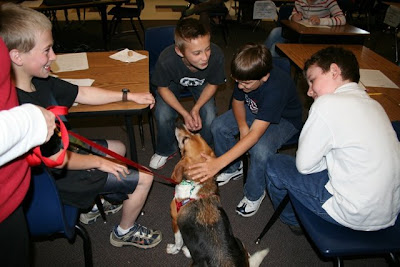

The Kendall kids get to know Buddy. He's since been adopted. Their hard work helped find him a home.

Buddy puts his nose into smelling his surroundings.

Wednesday, June 10, 2009

Seeking shelter from cynicism

Claire and Emily offer bedding and food treats to go with animals leaving their shelter.

I've always been more interested in rescuing animals than raising children. Until recently, I didn't even understand the appeal of child rearing.

At 40, I'm finally starting to get it.

Lately I've been talking to kids about saving animals, and it's a completely different experience than speaking to adults on the same subject. Kids stare in amazement and hang on to every word, thrilled at the prospect of what can be accomplished. They ask how they can make a difference and save lives themselves. And then they do something I'm always begging adults to do, and -- I admit it -- not always so successfully at that.

They take action. And they do it without being prodded, guilt-tripped, shamed, cajoled, sweet-talked, bribed or threatened.

Last night I witnessed the beauty of kid power in action again. I took a break and headed north to Vancouver to visit some old friends I haven't seen in ages. One of the couples has an adorable pair of little girls, and shortly after I arrived, the kids took an interest in my SUV. The grey Honda Element has an eye-catching red magnet stuck on the back that reads Animal Rescue Transport Vehicle.

Claire, who is almost four, and Emily, nearly 7, were excited and wanted to peek inside.

I gave the go-ahead and opened all the doors wide. The girls promptly scrambled in with their bare feet and started crawling around fascinated, checking out all the tools of the trade I keep stashed in there.

Here's what they found. A foldout cardboard carrier and a small box for housing stray or injured animals. Towels and blankets. Bottled water. Cans of cat food. Several leashes in a variety of styles. Long Kevlar gloves to protect hands and arms against bites. A protective mask with a carbon filter in case I happen upon an ammonia-laden hoarding house. First aid kit. A T-shirt identifying me as an animal rescuer. Yellow sticks of chalk to write license plate numbers on my dashboard when I spot dogs flying around loose in the back of pickup trucks.

As Claire and Emily gazed at the contents of the car with their big round curious eyes, I told them about some of the animals who have been transported in my renegade rescue vehicle. Dogs, cats, even a bird and a mouse in the last few days alone, I explained.

Unbeknownst to me, the girls hadn't just been listening idly. I later found out that they had been soaking up the information like little sea sponges.

The adults chatted after the meal, and the kids slipped away from the table to play. Soon they returned, pressing a round plastic disc into each of our hands. The tokens represented money, they informed us. Each one could be redeemed for an animal.

Then they led us to the project they had been working on while we relaxed.

To my sheer amazement, three-year-old Claire and six-year-old Emily had set up a mock animal shelter. Using some blankets, they positioned the living room furniture and tented a perfect mini-model for a temporary disaster facility. I crawled under the tent and found an array of plush and plastic toys laid out in a horseshoe arrangement. Each animal was nestled into a size-appropriate makeshift kennel, such as a mixing bowl or a Tupperware.

When I go to animal rescue disaster training, we stage exercises that resemble Claire and Emily's project. We set up mock animal shelters, just on a larger scale. These kids did it without being told. They saw the car, imagined the animals that would be arriving in it, and figured they would need a place to put them.

It was logistics genius in its purest form.

Emily and Claire were waiting for us under the tent with the animals they had up for adoption. They questioned each adult about what kind of pets we were looking for -- including our particular desires and habits -- and determined which animals were best suited to us.

And then the girls really impressed me.

"Before you go, pick up a blanket and some food for your animal," Emily said, pointing to an area beside the tent. The girls had raided their toy collection and lined up miniature mismatched supplies to go with the animals to their new homes. We were instructed to choose a tiny scrap of bedding and a plastic food item, which were obviously bits and pieces gathered from other toy sets.

I could have cried at the simple, shining beauty of it all.

The animals need the optimism, energy and hope that the next generation of kids like Emily and Claire bring to the mission.

And, for that matter, so do I.

This isn't the last you'll be hearing of Claire and Emily. I'll be back to play Animal Rescue with them again, and this time it might not be just fun and games. When we finished going over all the items in my car, Emily made it clear that the kids didn't want to stop at make-believe.

"Can we go out and start rescuing animals now?"


The girls set up a place to house rescued animals.


Emily and Claire supervise the animal adoption area of their makeshift shelter.

Sunday, June 7, 2009

This Penny brought me good luck


Penny says goodbye to a place she called home.


We all know what it's like to say goodbye to a dear friend who's moving away. Your happiness for their exciting new opportunity is edged with sadness as the magnitude of what you are losing begins to dawn. You promise to write, to call, to keep in touch. Sometimes you do. More often you don't.

And when the person leaving you has been a life force for your life's mission, the feeling of loss goes beyond the parameters of the average friendship.

I first met Penny Cistaro in 2001, shortly after moving here. I had loaded up a rented RV full of cats and moved from southern California to northern Washington State, where Penny worked as the executive director for the shelter in town.

In any new place I land -- and I've lived in many -- it's not long before I get to know the local animal shelter for one reason or another. This time, it was two feral cats I had found living underneath a trailer outside an engineering firm in Bellingham. I had trapped the cats and called the shelter to see if they would help fix them. Penny met me outside the gates of the Whatcom Humane Society (WHS) to collect the cats and check them in for surgery before the shelter opened.

That was the beginning of a friendship that saw a long parade of animals pass from my hands to Penny's. Cats I found sitting in the middle of the road, not street-smart enough to know any better. Unwanted pit bulls dumped outside my country home. Stray dogs I rescued running on the freeway. Cats who survived the floods of New Orleans following Hurricane Katrina. Even a bullfrog who had been run over in an industrial park.

Though many of the animals didn't get their happily-ever-after endings, something always gave me comfort when an animal's story ended less than brightly. It was Penny's arrow-straight judgment and natural competence. Once the animals I had rescued were nestled safely in her care, I could drive away from the shelter knowing that I could relax. That they would suffer no longer, and be treated with compassion and respect.

The more I saw of this little shelter that could and its fearless leader, the more it inched its way into my heart. Penny, always the master delegator, saw something in me too, and promptly enlisted me as the shelter's ghostwriter. Since then, I have written extensively about WHS -- both the animals that ended up there, and the staff and volunteers who nurtured them along the way.

I've been doing animal rescue for 20 years, and Penny taught me more about the field than any other individual ever has. In particular, she opened my eyes wide to the struggles faced by shelter workers forced to euthanize because of the epic overpopulation crisis. And she taught me not to beat myself up when I lose one. You can't save them all, but you can save them one at a time.

This past weekend was Penny's last one here. Just before she left, I brought her some packing boxes. But in the end, we couldn't even bear to say the word goodbye. By Sunday, she was simply gone.

Monday morning was Memorial Day, and I was back in the shelter again, this time with an injured field mouse. The place felt different without her being there, although I was in good hands with the fantastic crew that Penny has trained and left behind to carry on with the life-saving work. Her spirit remains.

And while our local community has lost a gem, the animal rescue community hasn't. With nearly 35 years of shelter work behind her and a career that spans coast-to-coast, Penny's not retiring from the business just yet. This time, I'm staying up north, while Penny goes south to California. She started work last week in Sacramento, where she'll be running the city's Animal Care Services department.

Congratulations on your new opportunity, Penny. But just so you know, I'm not ready to call this goodbye. I'll be in Sacramento to visit you soon. And if history is any indication, I won't be coming empty-handed.

This is the look Penny -- or PC as I prefer to call her -- gave me when I told her she couldn't leave because I have abandonment issues.


Bellingham dentist and WHS board member Faith Bult comforts a teary-eyed Penny at the goodbye party thrown in her honor at Boundary Bay Brewery, a local hotspot.


Northshore Veterinary Hospital owner Kim Barron, also a former board member, came to the event with her kids in tow to say goodbye to Penny. Kim is also my vet, by the way.

When your mom's a vet, healthy choices come instinctively.


Wednesday, May 27, 2009

Tina May's Great Escape

Tina is cuddled by Jess, a RAPS volunteer dog walker.


Tina the terrier has a vice, and it's landed her in trouble more than once.

She suffers from severe separation anxiety. And children supply the antidote.

When Tina's left alone and hears kids' voices, she can't help running away to join up with the fun. That's probably what earned this escape artist a spot in the shelter in the first place.

And then, when someone adopted Tina from the Richmond Animal Protection Society (RAPS), she was discarded again because of her habit. Tina hadn't been living in her new home long when she took off to track down some kids. Animal control picked her up at a nearby schoolyard.

"She bonds with you instantly, and then wails if you try to leave her," said RAPS executive director Carol Reichert.

Tina's guardian came to collect her, but she wasn't thrilled about her new pet's sense of adventure. The next day, she listed her on Craigslist for $200. Thankfully RAPS staff members troll the listings religiously, and promptly got Tina back.

This past Saturday, Tina was at it again. It was her last weekend at the shelter. A retired couple had fallen in love with the little dog and planned to pick her up on Monday for the trek back to their home in Victoria.

But mischievous Tina had her own plans for a Great Escape.

A little girls' birthday party was happening at a house across the street, and it proved too much for Tina to resist. As Carol prepared to close up for the night and hauled bags of trash out to the dumpster, stealthy Tina slipped past her feet unnoticed.

It was getting late when Carol left, after 8:30 p.m. But Carol, one of the hardest-working shelter directors I've ever met, wasn't done with her workday yet. At 11:30 p.m., she returned just to check in on her charges and make sure everyone was tucked in safely.

You can imagine how her heart dropped like a stone when she discovered that precious Tina was missing from her spot in the lobby, where she hangs out all day greeting visitors.

Despite the late hour, Carol swung into action telephoning staff, asking if they'd returned to take Tina home for the night. No one had. But they weren't going to let Carol fret alone. She was soon joined by others in the search for Tina.

"It touched my heart because of what good staff we have," Carol said.

Someone thought to check the voicemail, and there was a message from a neighbor who had guessed Tina was a shelter dog. She had headed across the street to visit seven little girls who got together to celebrate a birthday. Tina was an instant hit, and the appointed guest of honor.

"When I got to the house, seven little girls came running out," Carol said. "They were holding Tina saying, ‘We named her May.' They had been playing outside and she ran right to them. She just runs right up to anyone. They had a ball with her."

So what does the future hold for this escape artist who finds child's play irresistible?

"These people have promised they'll only be away from Tina on Sunday mornings for an hour when they go to church, and they said if Tina was upset by that, they would take turns," Carol said.

Friday, May 15, 2009

Here's to you, Sonya!

RAPS' assistant manager Sonya Kamp models this year's most humane accessory -- a shelter dog.

Sonya Kamp is one of my favorite shelter workers.

She's always got a grin on her face when I stop by her shelter. Even on the days that would choke some of us with sorrow, Sonya soldiers through them free from rage or harsh words. I am in awe of her state of perpetual good cheer.

When I walked into the Richmond Animal Protection Society near Vancouver yesterday, Sonya was working the front desk while cuddling this bit of pup who looks like a cross between a Shih Tzu and a guinea pig. Four-week-old Katie was away from her mom for the first time. While Mom was being groomed, Sonya was keeping Katie warm and mothered.

As soon as I pulled out my camera, Sonya started to give me a little show modeling the pup as her accessory. I told her the pictures were going to make the blog. Let's see if I can make her blush.

This one's for you, Sonya. Keep smiling. ☺


Hope shines from shelters

Birds in a barrel: these adorable ducklings were rescued from a roadside.


I'm always talking to animal-loving citizens who are too scared to go near a shelter. I understand their fears, because I used to be one of them.

I viewed shelters as places soaked in sadness. Row after row of lonely eyes looking mournfully from behind bars, eyes that seem to be pleading for clemency.

But then I started to research the comings and goings of shelter daily life. The more time I spent behind shelter walls, the more I realized how wrong I was. It's true that I witnessed tragedy and heartache at times, particularly in the back areas that the public doesn't see. But I also experienced hope and inspiration of mind-altering magnitude.

I started shedding my prejudices and began to look forward to visiting my friends on the front lines of animal rescue. They care for their charges as if they were their own, nurturing animals who have been thrown away by society with patience and compassion.

Shelters are filled with animals with sad stories, but there are umpteen happy tales there, too. Animals whose pain has been soothed. Those who finally have a place to lay their head, a pit stop that's replete with fresh clean water and delicious food. A safe haven where they are loved and comforted by staff who have devoted their lives to rescuing them.

Unfortunately the public's fear of shelters has a negative impact on adoptions. Some people opt to buy animals from breeders or pet stores rather than brave a visit to the local shelters. What a shame.

Yesterday I visited the Richmond Animal Protection Society. Check out some of the current residents.


No one knows where the mother of this duckling disappeared to.


A tiny furry pod of baby bunnies is off-the-charts adorable.


Poor Pandora refuses to eat, despite the tasty treats that are strategically placed near her snout. She was rescued while running through rush-hour traffic on the freeway near the Alex Fraser bridge. It took animal control officer Shane Burnham more than two hours of chasing Pandora on foot before he finally caught the terrified dog. She was so afraid that she mutilated the catch pole used to capture her. "Shane saved her life," said RAPS executive director Carol Reichert. "He phoned in after an hour, but we had no other calls for him, so the chase continued on. She kept trying to get back onto the highway. He had to run through fields and blackberry bushes to get her."


Texas was rescued on the grounds of the Vancouver International Airport while running inside the fenced areas. He could have sprinted along the airplane runways had he wanted to. Texas was riddled with infected open sores, and a rotting tooth indicated he sustained a forceful blow to his face.

But look how happy Texas is now...


This shelter is always coming up with innovative ideas, and here's a good one. They've buried three plastic pails in the dogs' play yard, punched holes in the bottom, added a solution called Septonic, and turned them into composters. No wasteful plastic bags required, and the results will be great fertilizer.


The shelter animals and the people who care for them always appreciate a friendly face, a donation, or even a helping hand. At RAPS yesterday, this local manufacturer dropped by with an offer to use her fabric remnants to make soft felted cushions for the shelter cats. Carol (on left) was thrilled. Gestures of support from community members such as these keep the staff's mood upbeat.